
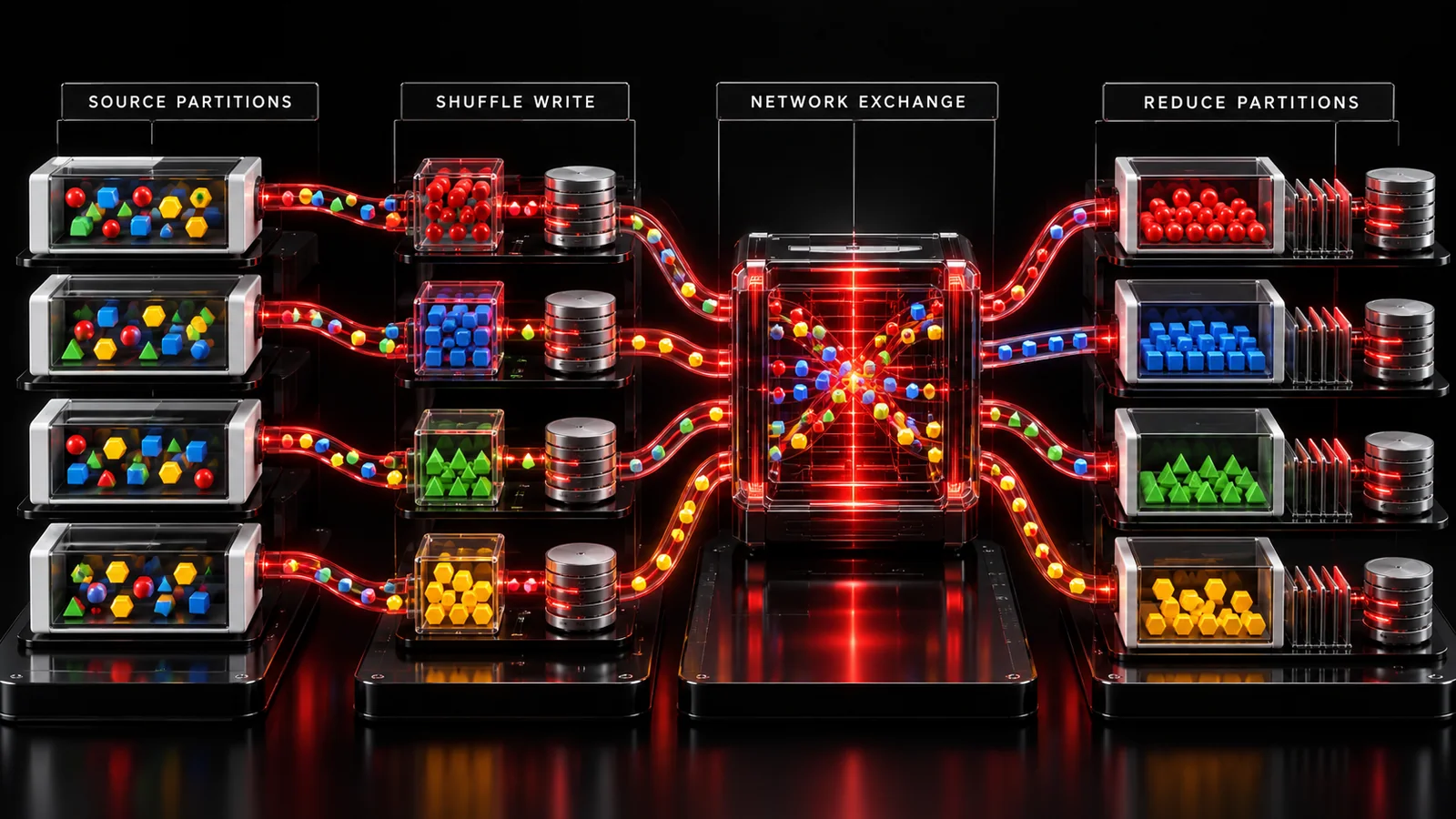
A partition can be processed independently only while all required records are already together. Grouping, joining and repartitioning often require records with the same key to meet on another executor. The shuffle is the machinery that makes that redistribution possible.
Local work ends at a dependency
A filter can usually evaluate each partition without consulting another partition. A groupBy customer_id cannot finish locally when the same customer appears in many partitions. Spark writes intermediate shuffle data, transfers the relevant blocks and lets downstream tasks read the newly partitioned result.
Shuffle cost has several parts
The expense is not only network traffic. Serialization, sorting, disk spill, many small blocks and uneven partition sizes can all contribute. A stage with one abnormally slow task may indicate skew; a broad slowdown may instead reflect larger volume or insufficient resources.
Do not diagnose a shuffle from its name alone. Compare bytes, spills, task duration and partition distribution.
Reduce data before moving it
Filter unused rows and project unused columns before wide operations when semantics allow it. Pre-aggregation can also reduce transferred data. A broadcast join may avoid shuffling a large side when the other side is genuinely small enough, but broadcasting an oversized relation moves the problem into executor memory.
from pyspark.sql import functions as F

facts = spark.table("main.sales.order_lines")
dim = spark.table("main.reference.products")

result = facts.join(F.broadcast(dim), "product_id")
result.explain(mode="formatted")
The broadcast hint is illustrative, not automatically correct. Validate relation size, executor memory and the physical plan before forcing a strategy.
Partition count is a workload decision
Too few output partitions can create long, memory-heavy tasks; too many can create scheduling and file overhead. Adaptive Query Execution can adjust parts of the plan at runtime, including coalescing shuffle partitions and handling certain skew patterns, but sensible statistics and data design still matter.
Tune the work distribution you measured—not a universal partition number copied from another cluster.
Go to the source
Keep learning with the official documentation.
Apache Spark: SQL performance tuning ↗Apache Spark: RDD programming guide ↗